Wetlina
The name Wetlina comes from a type of willow, in Ukrainian wetlyna. The first mentions of an already settled Wetlina date from 1580. The village was divided into three parts: the oldest and lowest - Stare Siolo, the middle part - Zabrodzie, where the church stood, and the highest from the Solinka river to the pass above Berehy - Osady. In the interwar period, the village had 152 houses and 1,037 inhabitants (1938 data), stretching 6.5 km in length. The inhabitants were mainly engaged in the breeding and grazing of cattle, horses, and sheep. A mill was located in Stare Siolo, and a school in Zabrodzie. In the 1930s, a Border Guard post stood at the edge of the village toward Moczarne. The village also had a forestry office, a potash works, two blacksmiths, three oil presses, two taverns, a cobbler, several wheelwrights, three shops, and a cooperative. Where the post office recently stood, there were manor buildings.
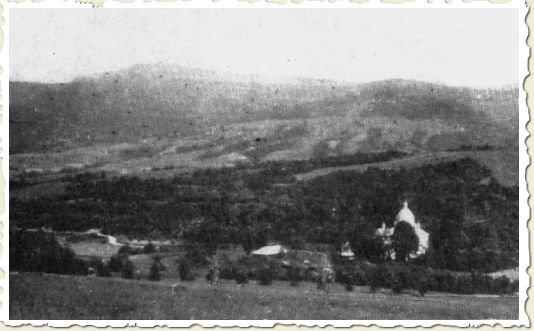 Wetlina circa 1935
Pre-war houses in Wetlina were typical wooden thatched cottages (chyzhy), mostly without chimneys. Wells with sweeps only appeared in the interwar period. The road was unpaved, and the bridge over Wetlinka was wooden.
During the German occupation, one of two Jewish families living in Wetlina was completely murdered. The most tragic moments began with the entry of the Red Army in late September 1944 and NKVD in November. The liberators began repressions and persecutions, primarily targeting the most educated people and those involved in the Ukrainian independence movement. After the army left, the village fell under UPA influence, whose fighters the NKVD removed in spring 1945. In summer, the Polish Army entered to displace residents, though this was only accomplished in 1946. The remaining inhabitants were finally deported in May 1947, leaving Wetlina completely empty. Houses were burned and destroyed. Most displaced residents ended up near Stanislawow (Ivano-Frankivsk) in Ukraine; many were arrested and sent to the camp in Jaworzno. The village was reborn only in the 1960s with the revival of the forestry industry.
Greek Catholic Church in Wetlina
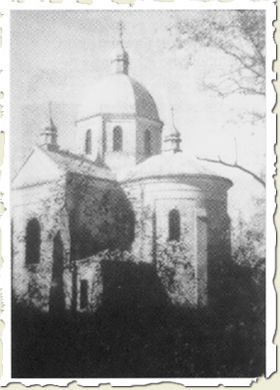 Greek Catholic church in Wetlina
The first wooden church dedicated to St. Great Martyr Demetrius was built in 1786. It measured approximately 22 × 8.5 m with three log-frame crownings, standing about 70 m northeast of the current church. It was demolished after a new church of Christ the King was built in the interwar period. It was one of the largest churches in the Bieszczady, built of brick on a cross plan measuring 60 × 40 m with a slender dome. Construction was completed in 1928, but by 1939 it had not been fully finished. Next to the church stood a wooden bell tower with two bells; to the south was a cemetery. In summer 1946, the interior was burned by Polish Army soldiers, and the walls were blown up by Border Guard soldiers in 1950. Only part of the dome wall survived, which was used to build a chapel dedicated to the Mother of God. The only surviving icon is in the museum in Sanok.
Roman Catholic Church in Wetlina
A Roman Catholic chapel was illegally established on July 28, 1973 from a wooden shed next to the war-destroyed church, purchased for demolition from the Wetlina Forestry Office by Fr. Antoni Kolodziej, the parish priest of Cisna. The authorities attempted to destroy it with a bulldozer. For several days and nights in August 1973, residents guarded it and prevented its demolition. In 1979, a wooden church was built without permission on the site of the former chapel. The Archbishop of Przemysl, Ignacy Tokarczuk, consecrated the church and entrusted it to Franciscans of the Bernardine Province, establishing the Parish of Divine Mercy on June 14, 1980, covering the territory of Wetlina, Smerek, Kalnica, and Strzebowiska.
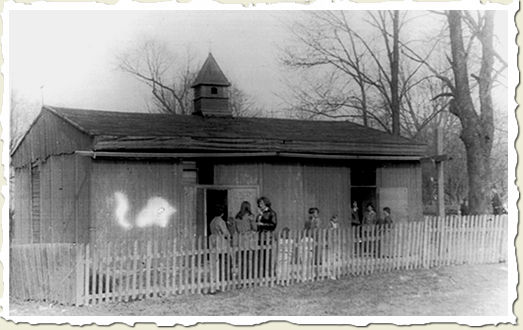 First Roman Catholic chapel in Wetlina
The current parish has approximately 570 members from all over Poland, who arrived in the late 1960s through the 1980s. Religious life centers around the parish church in Wetlina and the newly built filial church in Kalnica. Sunday and holiday liturgy consists of 4 Holy Masses at 8:00 AM, 10:00 AM, and 5:00 PM (from May to October) in Wetlina and at 11:30 AM in Kalnica. On weekdays, Holy Mass is celebrated at 5:00 PM (from May to October at 6:00 PM). The Sacrament of Penance is available daily, on holy days and weekdays before every Holy Mass.
Parishioners actively participate in religious life through small groups including altar servers, Franciscan Youth, Rosary Circles, the Parish Council, and the cooperative Volunteer Fire Department.
In 2017, a new church was completed and consecrated in Wetlina.
Franciscan House
The Religious House was built between 1984-1995 and serves as a monastery, parish office, and retreat center for organized groups and individuals. Its favorable location (next to the church, forest complex, near the picturesque Wetlina river and mountain ranges - Polonina Wetlinska) is conducive to working with children and youth and meets the needs of our times.
Monastery Superiors in Wetlina
Fr. Stefan Zwirek1980-1981 Fr. Anzelm Wiatr1981-1990 Fr. Aleksy Platek1990-1994 Fr. Karol Adamowicz1994-1996 Fr. Amadeusz Irzyksince 1996Kalnica
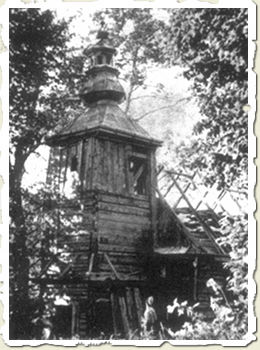 Ruins of the church in Kalnica, circa 1955
Settlement records for Kalnica date from 1552. The name derives from the Ukrainian kalnyj - muddy, soft, turbid, referring to the wetlands at the confluence of Wetlinka and Kalnicki streams. According to 1921 data, the village had 36 houses and 217 inhabitants. There was a post office, police station, manor, steam sawmill, bent wood furniture factory, water mill and sawmill, fish ponds, and until 1918 a hydroelectric power station. It was the terminus of a narrow-gauge railway to Majdan, built in 1900-1904, equipped with an engine house, turntable, and administrative and service buildings. The station had a telephone.
In 1946 and 1947, during Operation "Vistula", all inhabitants were displaced. The village returned to life only at the end of the 1950s.
Greek Catholic Church in Kalnica
The first church in Kalnica was built around 1700. The next, dedicated to the Holy Martyr Paraskeva1, was built in 1842. The church had a unique construction with elegant, onion-shaped helmets over the nave and presbytery. It was very similar to the church in Strzebowiska. Its remains still existed in the 1950s.
Roman Catholic Filial Church in Kalnica
The filial church of St. Francis was built between 1999-2003, on a TAU-shaped plan designed by architect Kazimierz Luczko from Przeworsk.
1 Several saints by this name are venerated in the Eastern Churches. Further historical research is required.
Smerek
This is the oldest village in the area - established before 1529 on the Niedzwiedz (Bear) stream flowing into Wetlinka. The name derives from the Ukrainian smereka - spruce. The 1921 census recorded 107 houses and 674 inhabitants. The village had a steam sawmill, two water mills, and a tavern. A branch of the Majdan-Kalnica narrow-gauge railway reached the sawmill in the Beskid hamlet.
The entire population of Smerek was deported to Ukraine by mid-1946.
Greek Catholic Church in Smerek
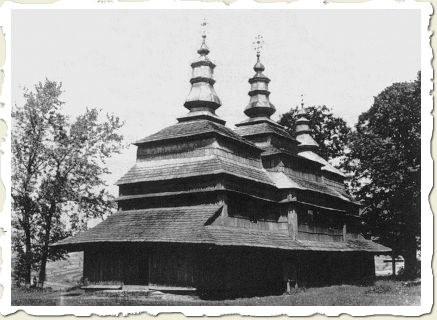 Greek Catholic church in Smerek
The parish church dedicated to St. Great Martyr Demetrius was built on the site of an earlier one in 1875. Next to the church stood a bell tower. Both were destroyed during World War II.
Strzebowiska
Formerly Strubowiska, mentioned in 1567. In 1921 it had 53 houses and 278 inhabitants. A narrow-gauge railway from Majdan to the Beskid hamlet in Smerek ran through the village. There was also a water mill, oil press, shop, blacksmith (who also played the fiddle), and a tavern. Strzebowiska was almost completely destroyed on March 21, 1945 during a battle between a UPA company and NKVD, Polish Army, and Citizens' Militia forces. In 1946, the inhabitants were deported to the USSR.
Greek Catholic Church in Strzebowiska
The last church in Strzebowiska, dedicated to the Nativity of the Blessed Virgin Mary, dated from 1843 and was very similar to the church in Kalnica.
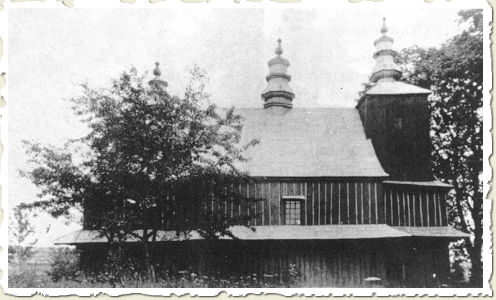 Greek Catholic church in Strzebowiska